 B
BAbout this program
OpenBionics Prosthetic Hand
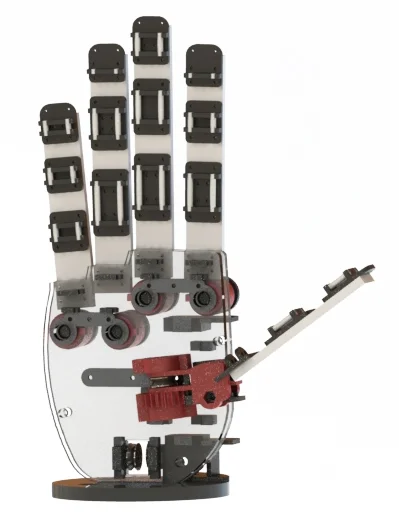
A low-cost, 3D-printable, fully functional anthropomorphic prosthetic hand. The OpenBionics initiative (openbionics.org) publishes designs that cost under $200 and weigh under 300 g, aimed at closing the gap between commercial prosthetics (often tens of thousands of dollars) and what an individual or clinician can fabricate themselves.
How it works
The standout feature is a whiffletree-based differential mechanism. A single actuator drives all five fingers — but because of the differential, each finger stops independently when it contacts an object. That one trick unlocks 144 distinct grasp poses from a single motor, letting the hand conform to a wide range of objects (cylinders, pinches, key grips, hooks) without per-finger control.
A set of small mechanical locks lets the user selectively block specific fingers, which is how grasp selection is done on the physical device — no complex EMG classifier required at minimum.
What you get
- Fully printable 5-finger right hand (mirror files for left also available in upstream repo)
- HerkuleX DRS-0201 smart servo as the single actuator
- Wire-driven tendons with a differential bar mechanism
- Parametric CAD — scale the hand to fit different users using anthropometry tables
- Optional body harness + breakout board for integration with EMG or button control
Canonical printed parts
palmDown,palmUp— two-part palm shellindex,middle,ring,pinky,thumb— finger bodies (multi-phalanx each)baseHerkulex— mount for the smart servomainBar,barIndexMiddle,barRingPinky— the whiffletree differentialFlangePlate— wrist interface
The upstream repo contains ~280 STLs total covering left + right hands, the HDM variant, lockable mechanisms, and the wearable harness.
What you can do with it
- Teleop grasping demos — use the orobot cloud surface to command preset grasps (open, power grip, pinch, tripod).
- EMG or button-driven control — the upstream Arduino code reads muscle signals or switches and triggers grasps. This program wraps that with a cloud-side trigger surface.
- Research platform — anthropomorphic, under-actuated, fully open — a good baseline for grasp planning, tactile sensor integration, and rehabilitation engineering projects.
- Education — the whiffletree differential is a genuinely elegant piece of mechanical design; students can print one in a weekend and understand underactuated grasping hands-on.
Ethics note
This is a research-grade design published for open study and community iteration. For clinical use as a medical prosthesis, local regulatory review, professional fitting, and ongoing care are required — 3D-printable ≠ ready to wear.
Attribution & license
- Initiative: OpenBionics (openbionics.org)
- Upstream repo: https://github.com/OpenBionics/Prosthetic-Hands
- License: Creative Commons Attribution-ShareAlike 4.0 International (CC-BY-SA 4.0)
- Homepage: https://www.openbionics.org/
Links
- Upstream: https://github.com/OpenBionics/Prosthetic-Hands
- HerkuleX servo docs: see RobotShop product page (original dst-robot.com manual URL is no longer available)
- Project page: http://www.openbionics.org/
Build Guide
Assembly guide and parts list: OpenBionics Assembly Guide
🖨 Print Files (25)
palmDown.STL
palmUp.STL
index.STL
middle.STL
ring.STL
pinky.STL
Required Hardware
| Qty | Part | Notes |
|---|---|---|
| 1 | HerkuleX DRS-201 smart servo (actuator) | Single actuator drives all 5 fingers via whiffletree differential |
| 1 | Arduino Nano or similar | Control board |
| 1 | Servo driver board | PCA9685 |
| 1 | 5V USB power bank | Power supply |
| 1 | 3D printed finger set | See STL files |
| 1 | Elastic cord (1m) | Finger tendons |
| 1 | Set of M2/M3 screws | Assembly |