Tiny Engineer
 B
BAcerca de este programa
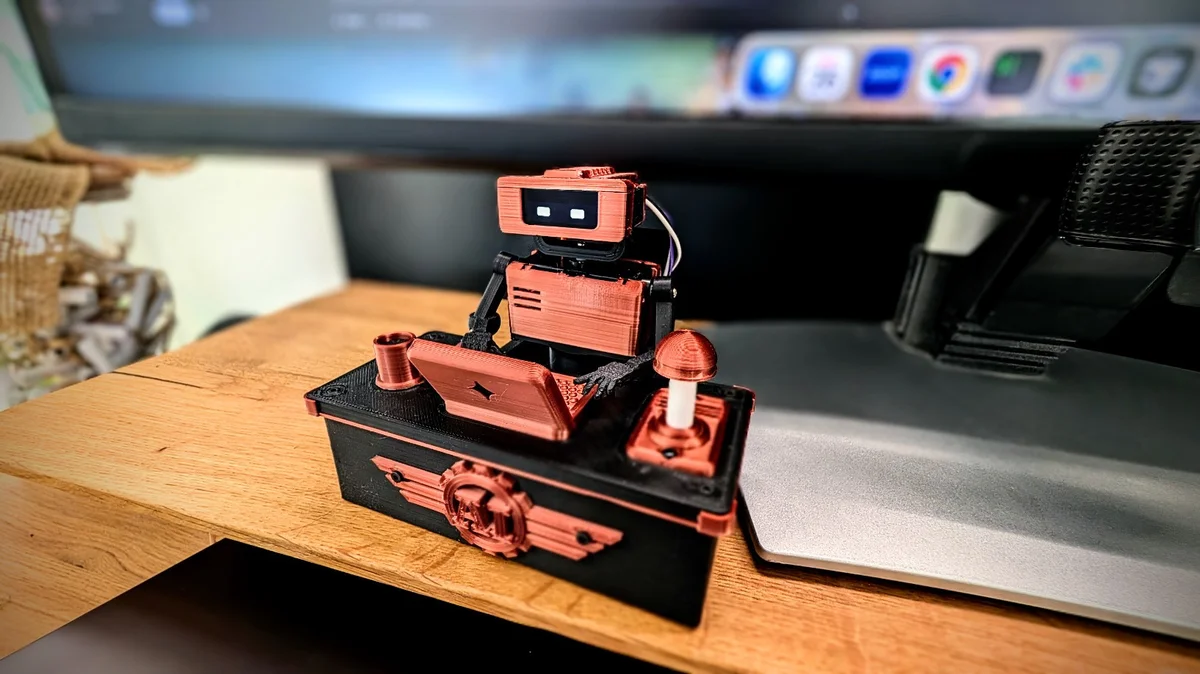
A tiny 3D-printed desk companion robot that physically reacts to what you're doing — reading, thinking, typing, celebrating a finished task — using 5 servos for head, neck, hands, and body, plus an OLED face and a speaker. It runs its own ESP32-C3 firmware over Wi-Fi and exposes a simple REST API (POST /anim?name=typing), so anything that can make an HTTP request can drive it — originally built to visualize what an AI coding agent (Cursor, Claude, Codex, etc.) is doing, but just as fun as a general animatronic desk buddy that reacts to timers, notifications, or your own scripts.
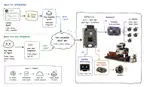
How it works: An ESP32-C3-Zero drives 5 analog micro servos (head tilt, neck pan, left hand, right hand, body rotation) through an Adafruit PCA9685 PWM driver over I2C, a small SSD1306 OLED shows a face/status, and a MAX98357A + speaker handle audio. Everything connects over 2.4GHz Wi-Fi with a built-in setup wizard (join TinyEngineer-XXXX, configure at /config).
This orobot.io Program is a learning entry point — it demonstrates the robot's 5-joint layout (head / neck / left hand / right hand / body) using orobot's motor + pose API so you can explore poses and sequences in-browser. It is NOT the robot's real firmware: Tiny Engineer ships its own dedicated ESP32 firmware and REST API (/anim, /settings, /test/*) documented in the source repo. To build and run a real one, flash the firmware from GitHub and connect your own AI agent integration.
Attribution & source: Created by Krzysztof Jamroz — source repository: github.com/jamro/tiny-engineer.
License (dual-licensed — read carefully before reuse):
- Firmware, integrations, scripts, and documentation are MIT licensed.
- Hardware designs — CAD source (
3d_models/cad/), printable.3mfexports (3d_models/parts/), and KiCad PCB sources (hardware/boards/) — are licensed under CERN-OHL-S-2.0 (CERN Open Hardware Licence, Strongly Reciprocal). Commercial use is allowed, but if you modify and distribute products based on these hardware designs, CERN-OHL-S-2.0's reciprocal terms require you to make the corresponding complete source available under the same license. See the repo's LICENSING.md for full scope. - The Tiny Engineer name and logo are not covered by either license (trademark).
STLs in this Program are the sg90 servo variant (Tower Pro SG90, the recommended servo). Two other printable variants (Feetech FS0307 for a more compact build, PowerHD HD-1370A for backward compatibility) are available in the source repo.
🖨 Archivos de impresión (19)
Head.stl
Neck.stl
UpperArm.stl
ForearmLeft.stl
ForearmRight.stl
Chest.stl
Belly.stl
Chair.stl
SeatLeft.stl
SeatRight.stl
Desk.stl
DeskTop.stl
Hardware requerido
| Item | Qty | Notes |
|---|---|---|
| Waveshare ESP32-C3-Zero | 1 | Main controller — Wi-Fi, I2C, I2S, USB CDC |
| Adafruit PCA9685 16-channel PWM/servo driver | 1 | Drives all 5 servos over I2C so ESP32 timing isn't the PWM source |
| Analog micro servo (Tower Pro SG90 recommended) | 5 | Head, neck, left hand, right hand, body. Feetech FS0307 for a more compact build; PowerHD HD-1370A also supported |
| Waveshare 0.91" OLED Module (SSD1306, 128×32, I2C) | 1 | Status / face display |
| MAX98357A I2S class-D mono amplifier | 1 | Digital audio out |
| 8 Ω / 1 W mono speaker | 1 | Paired with the MAX98357A |
| Adafruit 5993 USB-C breakout | 1 | Power (5V/≥2A recommended) + programming |
| 3D-printed structural parts | — | Desk, chair, body, head, hands, desk props — see printable parts |
Full inventory with electrical detail (voltages, addresses, pin mapping): docs/hardware/components.md.
No cost figures are published in the source repository — pricing above is left as "unknown" per part; these are all widely available hobbyist components (ESP32 dev boards, a PCA9685 breakout, five 9g-class hobby servos, a small OLED, a class-D audio breakout, a small speaker, and a USB-C breakout).
Explorar robots similares